
Punctuation on the SAT: Everything You Need to Know

The Digital SAT Reading and Writing section has 54 questions, split into two modules with 27 questions each. Each module includes the same 11 types of questions, which generally follow a consistent order: vocab first, then reading comprehension, and finally grammar and punctuation. This means that to get a high score on the SAT, you need to know the punctuation basics.
Thankfully, the SAT’s punctuation questions predictably ask about the same types of things, which makes it easier to prepare. This guide will outline everything you need to know about punctuation on the SAT.
Why is Punctuation important on the SAT?
Of the 54 multiple-choice questions on the SAT Reading and Writing test, roughly ten of them focus on punctuation. These questions all use the same format: they give you a paragraph with a section omitted, and you must fill in the blank with the answer that uses punctuation correctly.
Specifically, the SAT tests you on these punctuation symbols:
To prepare for the SAT, make sure you know when to use each of these. Thankfully, these punctuation symbols have distinct rules for when, and when not, to use them.
SAT Punctuation Guide: The Basics
To prepare for the SAT Reading and Writing portion, you should be familiar with commas, periods, dashes, semicolons, colons, and apostrophes. In the guide below, I’ll outline the basic rules for each.
Before we begin, it will be helpful to define a couple terms:
Independent clause: A complete sentence with a subject and verb.
My dog jumped over the fence.
Dependent clause: An incomplete sentence with a subject and a verb. Dependent clauses must be attached to independent clauses, using a comma.
After my dog jumped over the fence
Phrase: A group of words that lacks either a subject or a verb. A phrase must be attached to an indendent clause, using a comma.
During the game
All right, let’s dive into some SAT punctuation.
Comma

A comma places a pause in a sentence. Whenever you want to put a short break in your sentence, without creating a complete pause like a period, use a comma. Commas work well for separating items in a list, connecting two independent clauses together (paired with a conjunction), or connecting a dependent phrase/clause to a sentence.
When to Use
Items in a list: Use a comma to separate items in any list that has three or more.
I like apples, blueberries, and bananas.
Complex sentence: Use a comma to connect a phrase or dependent clause (incomplete sentence) to an independent clause (complete sentence).
I wanted to watch the game with you, not them.
Because you are my friend, I’m giving you my fries.
Compound sentence: Use a comma paired with a conjunction (for, and, nor, but, or, yet, so) to connect two independent clauses.
I enjoy eating cheese, but it messes up my stomach.
Avoid
Using a comma to separate two independent clauses: If you want to use a comma to connect two independent clauses, you need to follow it with a conjunction (for, and, nor, yet, but, or, so).
Dash

A dash is basically a stronger version of a comma. It’s often used to connect a dependent clause or phrase to a complete sentence—with a strong pause between them. This is how a dash is used—to emphasize a pause.
When to Use
To avoid confusion with too many commas: Use a dash instead of a comma to avoid confusion when the added phrase itself contains commas.
I have always thought that Cheetos—not Funyuns, Lays, or Doritos—are the best chips.
Like a “super comma”: Use a dash just like a comma, but with greater emphasis on the “added” phrase or dependent clause.
My family loves Thanksgiving—just not as much as Christmas.
Avoid
Using a dash as a period: Dashes cannot substitute for periods. You cannot use a dash to connect two complete sentences. Only a period or semicolon can do that. And if you’re doing a compound sentence, use a comma instead (with a conjunction).
Colon

A colon can only follow a complete sentence. It precedes information that elaborates on the sentence, such as a list, example, or quotation. It’s basically like a period, but it introduces a list or example rather than a new sentence.
When to Use
Before a list: A colon comes after a complete sentence, before a list that elaborates on the sentence.
My teacher said I should bring three things to school: chips, plates, and napkins.
Before an example or quotation: After a complete sentence, before an example or quotation that demonstrates the sentence.
Mom says I’ve always been a handful: As a child, I would draw all over the walls with crayon.
Avoid
Using after an incomplete sentence: A colon can only follow a complete sentence. It cannot follow a phrase.
Semicolon

A semicolon acts just like a period; the only difference is that a semicolon indicates a close relationship between the two sentences. It’s basically a period that goes between two closely related sentences, where the second one builds on the first.
When to Use
As a period: Use a semicolon just like you would a period—between two complete sentences—but only when the sentences are closely related.
The NBA is full of talented players; Two of my favorites are Jalen Johnson and Anthony Edwards.
As a “super comma” in a list: You can use a semicolon as a comma between items in a list, for clarity, when the items are very long or contain commas themselves. This is the only situation where a semicolon can function as a comma.
There are dozens of critical organs in the body: the heart, which pumps blood; the liver, which clears toxins; the eyes, which help you see; and the lungs, which pull oxygen from the air you breathe.
Avoid
Using it as a regular comma: A semicolon usually functions like a period, not a comma. Only use a semicolon as a comma in the very rare case that your list items feature commas.
Period
You probably already know when to use a period. It goes after a complete sentence, and that’s the only time. Some writers use periods stylistically after phrases, sometimes even after one word, but the SAT will not ask you to do this.
When to Use
After a complete sentence: In conventional grammar, you can only use a period after a complete sentence.
I want to pet that dog.
Avoid
Using after incomplete sentences: As far as the SAT is concerned, you should not use a period after anything besides a complete sentence. Don’t use it after a phrase or a singular word.
Apostrophe

Unlike the punctuation marks above, the apostrophe has nothing to do with pauses. Instead, this floating comma indicates ownership, or fills in for missing letters in a contraction, such as don’t.
When to Use
To show ownership: Use an apostrophe before the final ‘s’ to show ownership—when someone possesses something. (Note: If the owner’s name ends with ‘s’, or if it’s a plural word that shares ownership, put the apostrophe after the ‘s’ at the end of the word.)
Singular (apostrophe before the ‘s’): This is Randy’s iPhone, so please give it to him.
Plural (apostrophe after the ‘s’): The Petersons’ home is across the street.
In a contraction: The apostrophe fills in for missing letters when you combine words to make a contraction (don’t, haven’t, would’ve, I’m, etc.)
We’re going to have a party later.
Avoid
Using for plural words without ownership: Remember that the apostrophe has two uses—ownership and contractions. Do not use it to make words plural: “
This is what the Peterson’s did in 2026.
The Comma-to-Period Spectrum
Excluding apostrophes, you can think of all the other punctuation marks listed above as a spectrum of pause intensity.
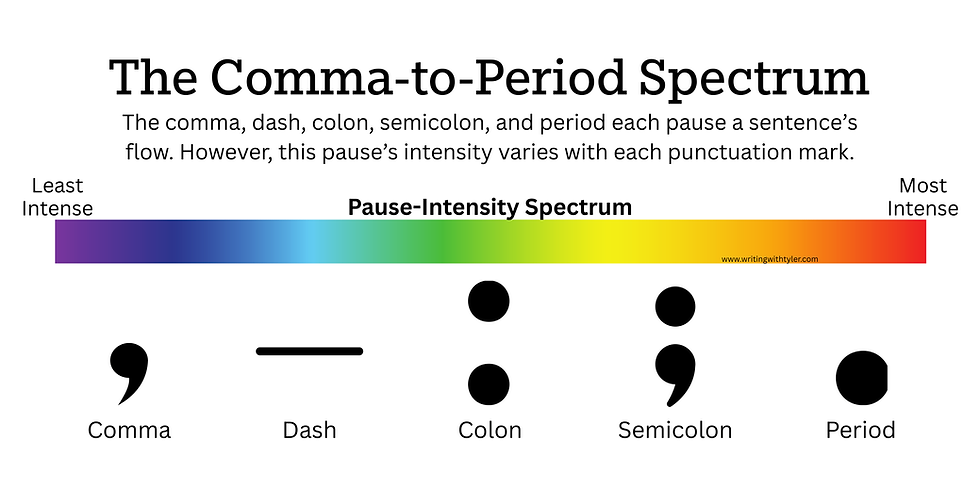
On one end of the spectrum you have the comma, the most common, which indicates a light pause. The dash is a more intense comma—if you really want the reader to notice an added phrase. Next, the colon starts to act more like a period, because it must come after a complete sentence but can be followed by an incomplete sentence. Finally, the semicolon is basically a period between two related sentences. At the end of the spectrum is the period: a full stop between complete sentences.
Best of luck on the SAT!

Thanks for sharing such useful information. An instagram reel downloader is one of those tools that saves both time and effort, especially when you come across reels that you don’t want to lose.